
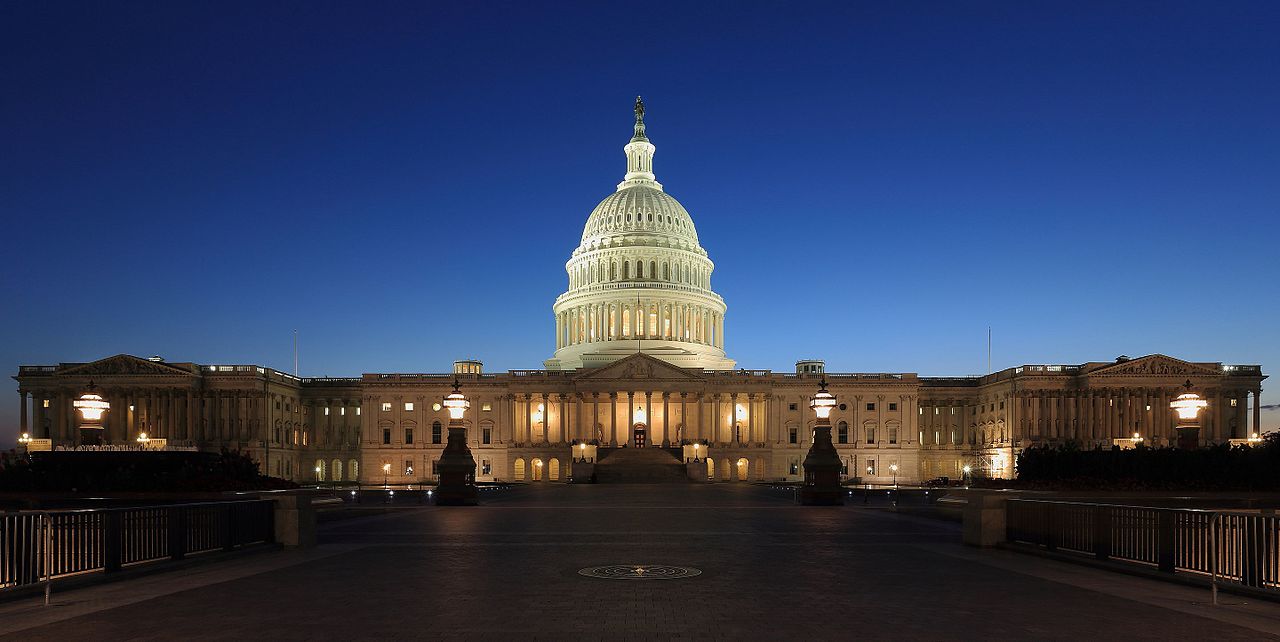
The US Capitol at dusk in Washington, DC. Photo: Martin Falbisoner, via Wikimedia Commons (CC BY-SA 3.0).
Two races left, and both are knife-edge
Two days after Democrats swept to control of Congress in the midterm elections, two Senate races remain too close to call — a cliffhanger in Mississippi and a slow count in Alaska — and neither is expected to be decided for days.
Democrats have already won enough seats to control the Senate, with at least 54 of the chamber's 100 seats when the new Congress convenes on January 3. The two outstanding races will not decide which party runs the chamber. They will decide the size of the Democratic majority — and in Mississippi, the outcome could be historic.
In Mississippi, Democratic challenger Scott Colom, a district attorney from north Mississippi, led Republican incumbent Senator Cindy Hyde-Smith by 1,138 votes, according to Associated Press results published on November 5, with about 96 percent of ballots counted. Colom had 464,926 votes, or 49 percent, to Hyde-Smith's 463,788, or 48.9 percent. If Colom holds on, he would be the first Democrat to win a Senate seat in Mississippi since 1982.
Why Mississippi is taking so long
The race is not expected to be settled quickly. Mississippi election officials are still verifying and counting provisional ballots — known in the state as affidavit ballots — along with mail-in ballots that continue to arrive. Mississippi Secretary of State Michael Watson said roughly 3,600 mail-in ballots remained to be tallied, plus an unknown number of affidavit ballots.
Voters who cast affidavit ballots because they lacked acceptable photo identification have until November 10 to present identification at a clerk's office and have their vote counted. Counties must submit their certified results by November 13. Mississippi does not require a candidate to win a majority in a regular federal general election, so the candidate with the most votes will win outright — but with the margin at about a tenth of a percent, the remaining ballots could still change the outcome.
Alaska's wait could last weeks
In Alaska, Democrat Mary Peltola, a former US representative, led Republican incumbent Senator Dan Sullivan by 626 votes, according to the Associated Press, with about 74 percent of ballots counted. Roughly 80,000 ballots remained uncounted, and the outcome could take weeks to resolve.
Alaska uses ranked-choice voting, under which voters list candidates in order of preference. If no candidate wins a majority once the initial count is complete, a second round of tabulation is held. The state's Division of Elections has scheduled ranked-choice tabulation for November 18, to allow time for eligible overseas ballots to be received and reviewed.
The race has drawn national attention, and not only for its closeness. Trump administration officials have raised concerns about potential certification challenges, and the contest is one of the most closely watched in the country.
What the results mean
The Democrats' Senate majority is already secure, but the final two races matter. A 55- or 56-seat majority would give the party more room to confirm nominees, advance legislation and withstand defections — and a win in Mississippi, a state Democrats have not carried in a Senate race in more than four decades, would underline the scale of Tuesday's realignment.
For now, both races remain officially uncalled. The Associated Press calls a race only when the trailing candidate has no remaining path to close the gap — and in Mississippi and Alaska, that moment has not yet arrived.
Sources: Associated Press; Al Jazeera; Agence France-Presse; TBS News.